Workshop 2 out of 3 in AHU’s “Teaching for Sustainability” crash course series is done! And here is a brief summary. For a more extensive one, check it out on my personal blog, here I just want to highlight some thoughts about student engagement that seem very relevant in the context of sustainability teaching.
In the framework of Teaching about, with, in, though, and for Sustainability, teaching through sustainability is about practicing sustainable ways of living and working with each other. And that is where I want to pick up:
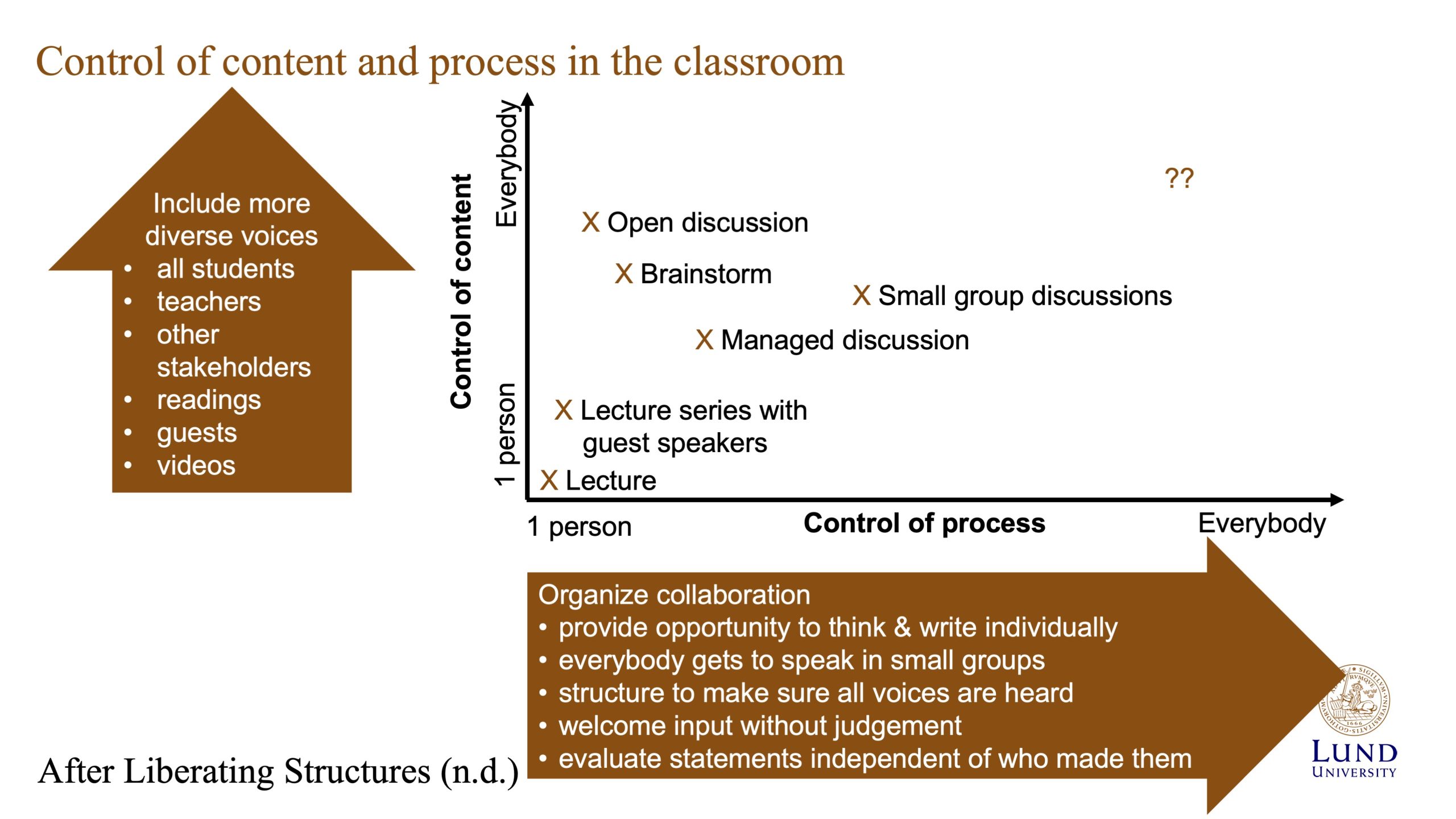
One approach that I find really helpful is to think about who controls content and process (see also the corresponding slide below). Often, a teacher has full control of both. They might try to actively involve students in their learning, for example through multiple-choice questions or minute papers, but the control rests with them. They might give up control a little and invite colleagues or external experts to speak in their course, but then it is likely still the main teacher or seminar organizer who controls the process, and at most a handful of people who control the content (and they were invited by the organizer). There are then of course more open models like brainstorming or discussions, but we are not very used to sharing control (or responsibility!) with students.
In general, if we want to move to more diverse voices, we can of course look at which perspectives we invite in guest speakers or in reading we assign, for example is everybody from the Global North?
And if we want to move towards sharing control of the process, this is basically about how we organize collaboration. Here it is important to give students the opportunity to think and write individually, then to make sure that everybody gets to speak in small groups, to structure larger group discussions to make sure all voices are heard, to make sure we welcome input without judgement, and to evaluate statements independent of who made them. And Liberating Structures are really a great collection of methods that can help us go in that direction!
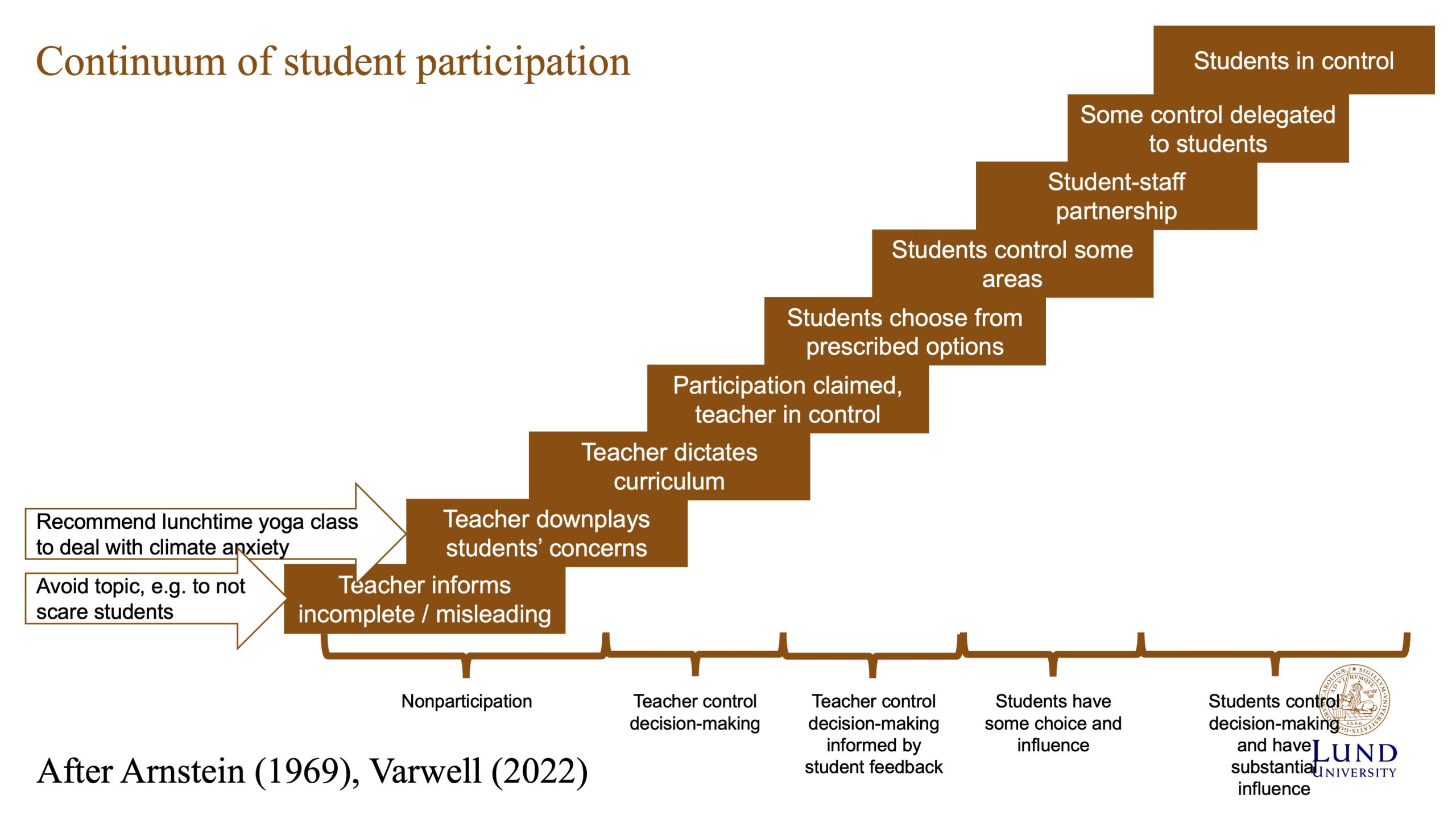
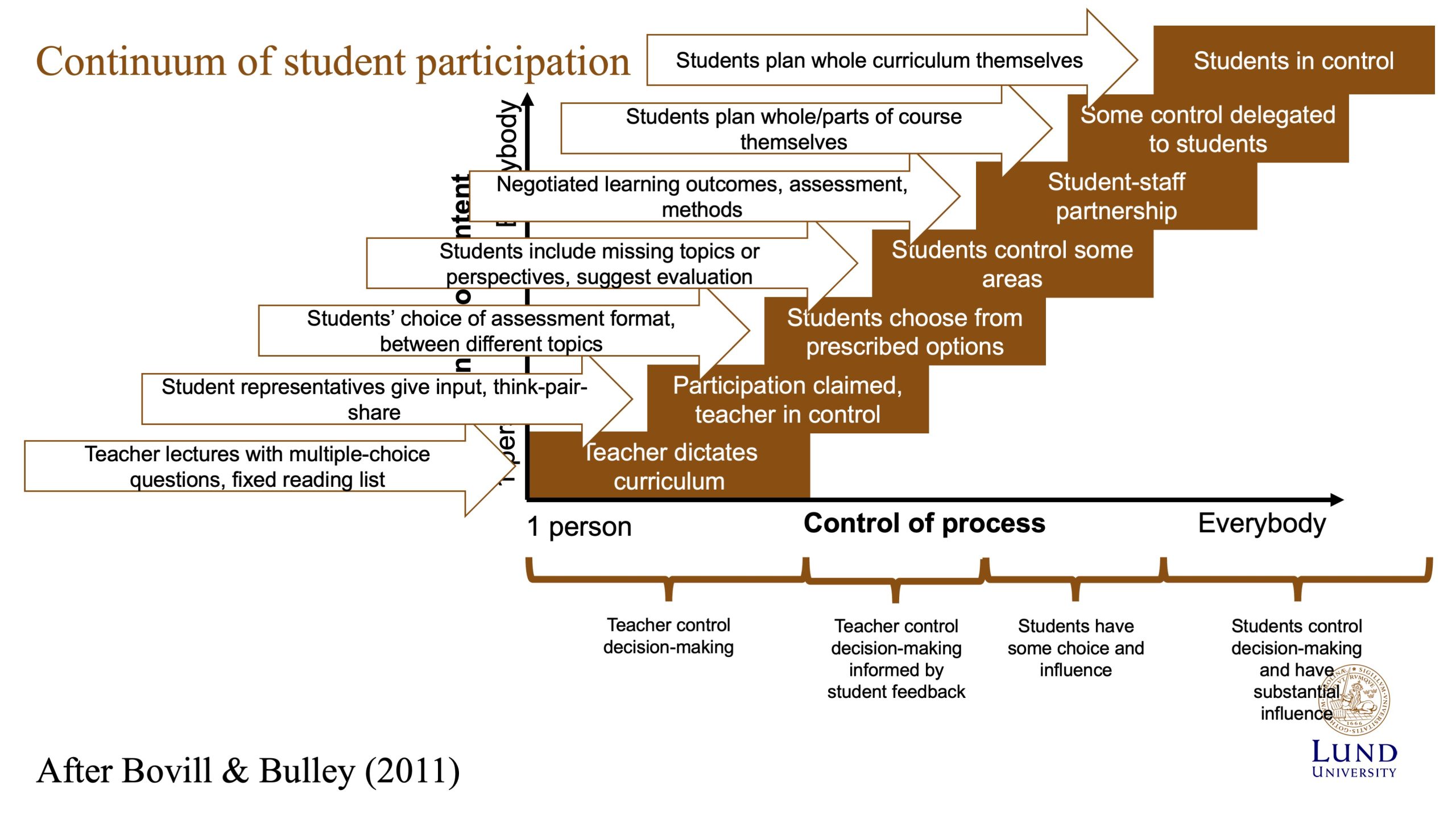
A classical way to talk about student participation is a continuum of student engagement (which I am showing here as discrete steps), where on the one end we have a teacher that “informs” students. On the other end of the spectrum, we could give students full control over what happens and let them plan a whole curriculum themselves.
And in between, there are many other steps:
- In addition to a lecture, we could ask student representatives for feedback or suggestions, or we could invite students to participate more actively through methods like think-pair-share.
- We can also provide several options, for example on different topics to focus on, or different assessment formats like video or podcast or text, and let students choose between prescribed options.
- We can even consider to give students control over some select areas: We could free up one class where students suggest a topic or perspective that they think is relevant in the context of the course. Or we could let them evaluate the course based on the criteria that they think are important.
- We can invite students into partnership and negotiate learning outcomes, or methods, or assessment, or all of those, with them
- And we can delegate some control to students and make them responsible for parts of a course, or a whole course, and just support them where needed and wanted.
Even though images of ladders and staircases always seem to imply that we are supposed to climb higher and higher, I don’t want to imply that that is the case here. Teaching always depends on context, and there is a time and place for all of these options! Even though I would argue that student-staff partnership is a good option to practice democratic processes in the classroom, there are also other ways to do that, and also to scaffold student responsibility by first giving choice between prescribed options, then giving students control of some areas, then inviting them into full partnership. Also we might want to start slow because we as teachers aren’t ready to give up control like that because we might be worried about what might happen if we do. So starting wherever you are comfortable and then maybe seeing if we can stretch a bit in the direction of partnership is a good approach!
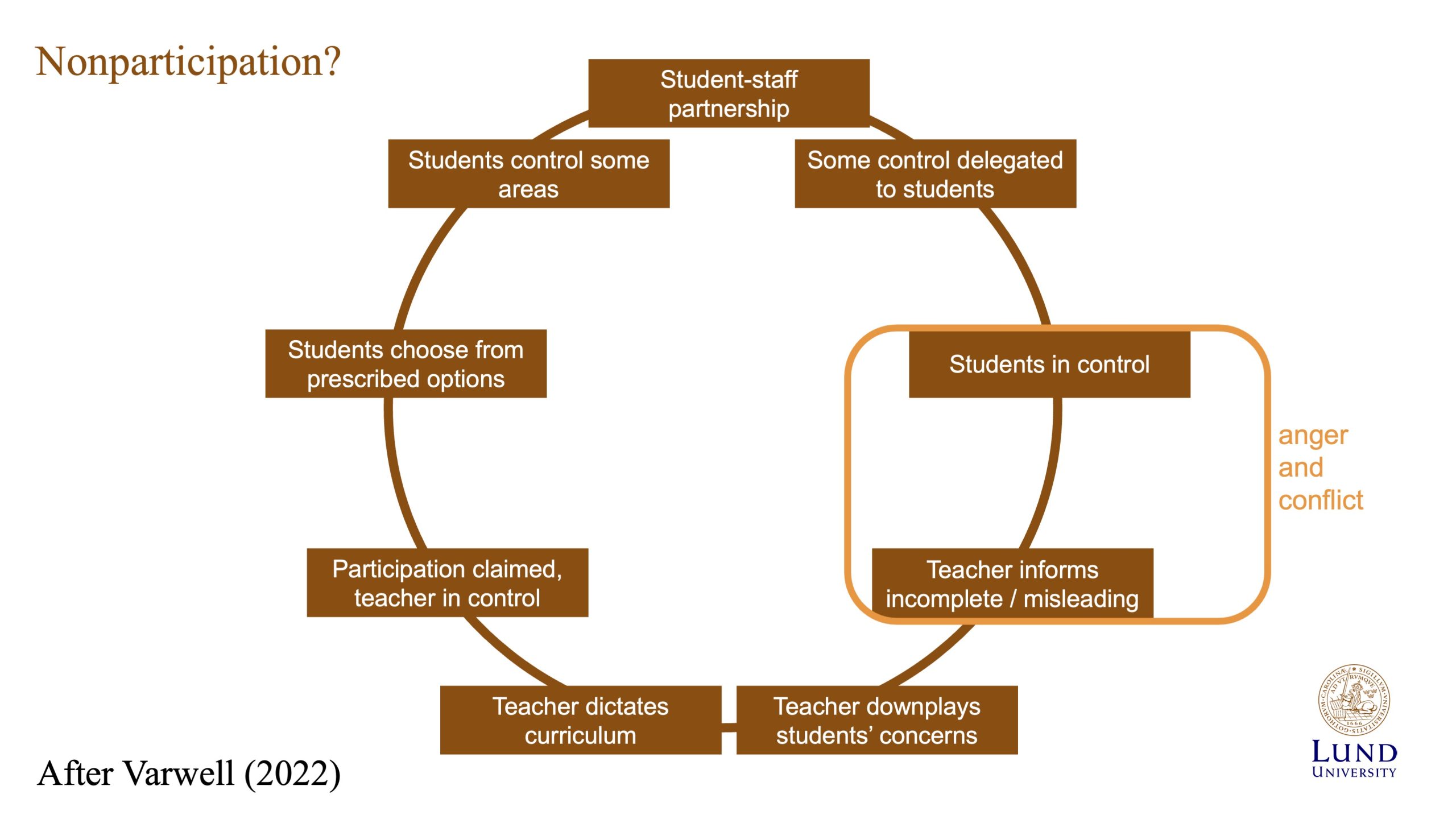
Interestingly, the ladder of student participation originally came from a ladder of citizen participation, published in 1969, and that ladder had two more steps that ideally would not exist in teaching and learning (nor in citizen participation, for that matter), so they have been dropped when we talk about student participation. Those steps are that students are not taken seriously, and the teacher conveying incomplete or misleading information.
Unfortunately, both do exist in teaching, and maybe especially when it comes to teaching sustainability:
- Teachers might react to students articulating concerns for their future by recommending that they take lunchtime yoga classes to deal with climate anxiety, when it is very clear in the literature that while mental health care is important, and an important part of dealing with climate anxiety (and I do not want to diminish that!), it is very important that students also develop the competencies and self-efficacy to become active and fight the root of the problem, not just work on the symptoms
- And about the incomplete or misleading information: teachers might avoid talking about the climate crisis, or any of the constituent crises of the ongoing polycrisis, and thus maybe not intentionally, but effectively mislead students. And there are many reasons why teachers might choose to not talk about difficult topics: Not feeling prepared to deal with emotions, not being the expert, not having time in the course plan…
But it is important that we do it anyway!
What we as teachers perceive as student nonparticipation might not really be that they don’t care, it might be that they care very much and we just don’t recognize that in our class. I have talked with teachers here at LU who told me about interventions that their students ran when they felt they were not being taught what they needed to learn in the context of sustainability! So what looks like disengagement and non-participation does not necessarily mean that the students don’t care and don’t want to learn.