
With this blog post, I hope to reach two audiences: educators who are beginning to integrate sustainability issues into their university curricula, and anyone curious about what studying sustainability science actually looks like from the inside — prospective students, peers, or simply interested readers. As a teacher with several years of classroom experience in both secondary schools and university, I know how difficult it is to make complexity tangible for students. Now, as a student myself in the MSc programme Environmental Studies and Sustainability Science (LUMES) at Lund University, I am on the receiving end of that challenge, and it has given me a new perspective on what works, what doesn’t, and what I wish I had been given on day one.
LUMES is an excellent learning environment for being introduced to sustainability challenges at different scales and levels, including their complex interactions. Every six weeks, a new course begins, and this rhythm forces us as students to quickly develop interest, motivation, and agency for new subjects. It is, in retrospect, good preparation for a professional world that requires constant adaptation, even if this pace sometimes prevents us from exploring certain topics as deeply as they would deserve.
What Actually Works
One of the highlights in my first year was to experience how all courses were interconnected through systems-thinking. Concepts and models such as feedback loops, multi-criteria analysis, or DPSIR were repeatedly part of lectures, group and individual projects. We applied qualitative and quantitative data analyses to chosen projects (e.g. effects of a highly subsidised public transport ticket on achieving national climate goals). And we had one full semester to establish a sustainability-related collaboration with a partner in the field (Knowledge-to-Action course), which was another highlight. My group, for example, worked together with Lunds Akademiska Golfklubb on a communication concept to make the golf club’s management practices regarding environmental compliance visible. By applying methods and concepts like Design Thinking and the SUCCESS Framework, together with the golf club we developed strategies to gradually shift public and golfer perceptions toward seeing golf as an honest and verifiable actor of sustainable development [1]. In that way, LUMES contributes to building a robust toolkit for managing sustainability challenges in the future.
In general, teachers and administrative staff at Lund University’s Centre for Sustainability Studies (LUCSUS) are very open about needs and demands we as students have. Embedded in this academic cosmos, they bring a critical, social-science perspective on sustainability into the classroom — a refreshing contrast to the mainly technical framing the topic usually gets in public debate. By letting us participate in decision-making processes regarding the focus of certain lectures or extracurricular teaching events, the learning atmosphere was usually very constructive. Our teachers noticed our desire to talk deeper about climate anxiety, so they invited climate psychologists who gave two workshops about coping with difficult emotions in an uncertain world. Higher education for sustainable development needs to create what ESD research calls “safe enough spaces”: learning environments where students can confront the emotional weight of sustainability crises without losing their sense of agency [2].
During small seminar exercises or, on a bigger scale, the mock COP (the annual UN summit dedicated to addressing climate change) event, we as students were encouraged to bring our individual, intercultural backgrounds into the problem- and solution-oriented learning process. I got the impression that our students, coming from more than 20 countries across four continents, genuinely enjoy these exchanges.
What’s Missing — and What Would Help
Overall, studying LUMES is mostly an intellectual challenge for me. We get a lot of interesting theoretical input, and the main focus of the assignments is of truly academic nature. What I sometimes miss, however, is more space to work systematically towards concrete solutions alongside this strong conceptual grounding. I notice that I still need practice in translating rich theoretical insights into actionable strategies for my future work as a sustainability professional.
Besides this pull toward theory over practice, two other gaps stand out in particular: the underrepresentation of adaptation and loss-and-damage, as well as a conceptual fuzziness around what ‘sustainability’ actually means.
Most of what we discuss in LUMES centres on reducing emissions and preventing further damage, which is essential. But adaptation, and honest reckoning with loss and damage that is already unavoidable, often get far less attention. Good sustainability education should hold both: the agency to act and the honesty to acknowledge what can no longer be prevented. Getting that balance right matters, because framing everything as solvable risks giving students false hope, while dwelling only on irreversible losses risks paralysis. Teachers need to create space for realism without tipping into despair. Emotions — from climate anxiety to hope to grief — are not peripheral to sustainability education; they are central to it [3].
Underlying all of this is a more fundamental gap: conceptual clarity. Sustainability and sustainable development are two different concepts, yet both are thrown around so loosely in public discourse (and sometimes even inside the classroom) that they have almost lost meaning. In society, especially in media, we often hear claims like “This backpack is more sustainable because it uses 20% recycling material!” or “Our newly designed, sustainable coffee pods are made with the future in mind.”, but also “We as a country want to be sustainable by 2050!” This is misleading and, in fact, simply wrong. Why? Because sustainability in its true understanding is an ideal state of human civilization in which the three standards of ecological viability, social equity, and sufficient economic performance are simultaneously fulfilled, intra- and intergenerationally [4,5,6]. Yes, achieving sustainability is possible, in theory. In practice, however, it entails highly demanding preconditions and will therefore, most likely, never be met [7]. Whereas sustainability is an ideal state, sustainable development is the ‘search process’ on the way towards sustainability, and is best expressed in the 17 UN Sustainable Development Goals (SDGs) [8]. This search process can sometimes lead to findings, sometimes it doesn’t.
I very much encourage teachers of sustainability science and people who practice ESD to be aware of this important differentiation. Otherwise, we will end up having graduates who leave universities and enter companies, the public sector, NGOs, or research institutions and contribute themselves to greenwashing. If you are designing a sustainability curriculum, this distinction is worth making explicit in the very first session. In my experience as a student, not having a clear conceptual anchor at the start made the following months feel unnecessarily disorienting — a lot of interesting content with nowhere to hang it. One concrete tool that helps prevent this confusion in research, in municipalities, companies, and in the classroom is a matrix for sustainable development (Figure 1). By applying this structure, sustainability challenges can be operationalised and thus better managed.
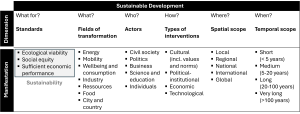
Figure 1: Operationalisation of sustainable development using a six-dimension matrix (adapted from Schmitt & Zinger, 2023).
The matrix operationalises sustainable development along six dimensions, asking: What for? (the three sustainability standards: ecological viability, social equity, and sufficient economic performance); What? (fields of transformation such as energy, mobility, food, or cities); Who? (actors, from civil society to business to individuals); How? (types of intervention: cultural, political-institutional, economic, or technological); Where? (spatial scope, from local to global); and When? (temporal scope, from short-term interventions under five years to very long-term ones spanning over a century).
In a teaching context, this matrix is a powerful orientation tool: it makes visible just how many legitimate entry points into sustainable development exist, and it prevents the common mistake of reducing the topic to one dimension — say, renewable energy — while ignoring the rest. Although the three sustainability standards need to be pursued at the same time, the remaining five dimensions can combine in 2,800 different ways. This underlines how many avenues there are to advance sustainable development and invites readers to identify projects that fit their own competencies and networks. There are, for example, projects that don’t include politics, others are only local or the time frame is very long (>100 years). This kind of structured, operational tool is precisely what I mean by a stronger focus on concrete solutions: something to work with, not just think about.
Taking this definition and the idea of a matrix together, sustainable development as a multidimensional operationalisation makes clear that it intervenes deeply and in diverse ways across essential societal sub-areas (fields of transformation). It therefore depends, on the one hand, on the scientific contributions of many individual academic disciplines — from the natural and engineering sciences to the social sciences and the humanities. On the other hand, the simultaneity of the three standards requires that these contributions are carefully coordinated with one another and addressed in an interdisciplinary manner beyond established disciplinary boundaries. Sustainable development thus becomes a collective task, and interdisciplinary work one of its key competencies [9].
Learning to Live with Complexity
After graduation, I will probably remember mostly that understanding sustainability in its entirety is virtually impossible. The reason for it became crystal clear during my first year: everything is connected, in all possible ways, all the time. Three semesters of lectures, seminars, and assignments can give valuable impulses and a broad overview of the field sustainability. Yet three semesters are nowhere near enough time to truly understand it. But that’s also not necessary, in my opinion. LUMES is extremely good in giving impulses towards every thinkable direction. Within a week, we can listen to lectures ranging from ocean politics to IPCC and policy formulation to carbon markets to suburban social injustices.
Looking ahead, the competencies I value most from this year are not subject-specific facts but meta-skills: navigating complexity, communicating across disciplines, and knowing that no sustainability challenge has a linear solution. These are best developed not through passive lectures but through exactly the kinds of active, collaborative, real-world formats that LUMES, at its best, already offers.
Sometimes, this can feel a bit like none of the courses are building up on the previous ones. Instead of seeing this as a lack of structure, I try to reframe it: I’m sitting in the lecture hall named Oström, curious and motivated to hear another story, and step by step these stories add up into a film called complexity. Later in my professional life, they will help me recognise patterns in specific challenges — and know which questions to ask, even when I don’t yet know the answers. Sometimes there won’t be any answers at all; that, too, is part of what sustainable development means. In the end, good sustainability education is less about handing out solutions and more about equipping students with the curiosity, tools, and conceptual clarity to keep asking the right questions.
References:
[1] Lunds Akademiska GK. (n.d.). Hållbarhet – Lunds Akademiska Golfklubb. Lunds Akademiska Golfklubb. Retrieved June 25, 2026, from https://lagk.se/klubben/hallbarhet/
[2] Singer-Brodowski, M., Förster, R., Eschenbacher, S., Biberhofer, P., & Getzin, S. (2022). Facing Crises of Unsustainability: Creating and Holding Safe Enough Spaces for Transformative Learning in Higher Education for Sustainable Development. Frontiers in Education, 7. https://doi.org/10.3389/feduc.2022.787490
[3] Grund, J., Singer-Brodowski, M., & Büssing, A. G. (2024). Emotions and transformative learning for sustainability: a systematic review. Sustainability Science, 19, 307–324. https://doi.org/10.1007/s11625-023-01439-5
[4] Berger, E., Hofmann, B., Feio, M. J., & Biber-Freudenberger, L. (2026). Aquatic food webs under stress—from science to action. Aquatic Food Webs in the Anthropocene, 357–378. https://doi.org/10.1016/b978-0-443-26538-9.00011-8
[5] Schmitt, M., & Zinger, B. (2023). Interdisziplinäres Arbeiten in BNE-Curricula – skalierbare Prozessmethodik als Gemeinschaftsaufgabe. Zeitschrift Für Hochschulentwicklung, 18(4), 93–116. https://doi.org/10.21240/zfhe/18-04/06
[6] WCED (World Commission on Environment and Development). (1987). Our common future: Report of the World Commission on Environment and Development. http://www.un-documents.net/our-common-future.pdf
[7] Campbell, N., McHugh, G., & Dylan-Ennis, P. (2018). Climate Change Is Not a Problem: Speculative Realism at the End of Organization. Organization Studies, 40(5), 725–744. https://doi.org/10.1177/0170840618765553
[8] UN (United Nations). (2015). The 17 sustainable development goals. United Nations. https://sdgs.un.org/goals
[9] Lozano, R., Barreiro-Gen, M., Lozano, F., & Sammalisto, K. (2019). Teaching Sustainability in European Higher Education Institutions: Assessing the Connections between Competences and Pedagogical Approaches. Sustainability, 11(6), 1602. https://doi.org/10.3390/su11061602
