
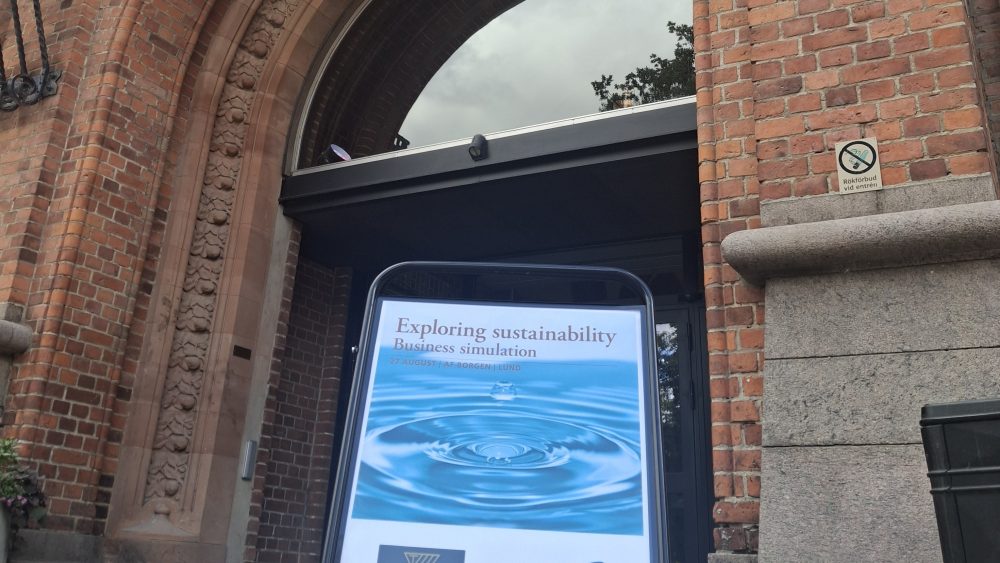
Lund University School of Economics (LUSEM) welcomed their new students from four different master programs with a full day of sustainability education! With around 250 participants running fictive companies trying to fulfill several indicators while dealing with uncertainty, trade-offs, and hard decisions, the room was full of energy and lively discussions.
Lund University School of Economics welcomed their new master students from four different study programs to AF borgen on 27 August for a kickoff with sustainability as the theme. The students were from the following study programs:
- Accounting and Finance – Master’s Programme (One Year) | Lund University
- International Strategic Management – Master’s Programme (One Year) | Lund University
- Managing People, Knowledge & Change – Master’s Programme (One Year) | Lund University
- Management – Master’s Programme (One Year) | Lund University
More specifically, the students (and representatives from four companies) were divided into teams and each team was tasked to run a fictive company called Omnia located at the “Global Island”. On the Global Island there were all kinds of actors with different wishes and demands including costumers, partners along the supply chain, and politicians. The task of each team – the participants – was to try to meet a range of indicators covering people, planet, and profit, as well as resilience, within the limits of a set budget, running the company over several years and working on short-term and long-term goals. The game is played over several rounds of around twenty to twenty-five minutes and for each round, more information is unlocked to the participants. Between rounds, participants had an opportunity to share their reflections with the rest of the room and to hear shorter presentations. “The CEO has got to go!” was one of the first thing that one of the teams shared, which generated a lot of cheering. Indeed, the company had not done so well on its ten indicators when the team was called in to fix it.
The day was organized by Ola Mattisson, programme director for Master in Management pogramme, and Ulf Ramberg, programme director for the International Strategic Management programme, with the help of fellow teachers and facilitators that were circling the room, responding to questions and supporting students.
Four real-life companies also participated as players in their own teams. The organisers thought about mixing participants but decided that the students should stay with their classmates as a way to get to know them and because they are facing a lot of new things anyway. This was day two of the new semester. The companies also had a small mini fair for the students to network and got some time on stage to share their sustainability work. This gave additional examples of some of the challenges that companies face when it comes to sustainability. For instance, one copper wire company talked about their thoughts on how to lower their impact on the environment as an actor that is important in, for instance, the electrification process towards the green transition, but also mining, which is a problematic activity in many ways.
Bringing in companies might not always be an option, but for this occasion it seems to have been a good way to bring practical experience and cases students could learn from in addition to the game setting as well as meeting potential employees, and the companies got to share information about themselves and have a day of competence development in sustainability.
The simulation used was provided through a company called CELEMI, which is established in more than seventy countries Our Sustainability Simulation – CELEMI Sustainability™ (there are ways to do large scale simulations or games that do not require buying external services too. We have written about serious gaming before e.g. An Evening of “Serious Gaming” with Playful Colleagues — A Guest Post by Ester Barinaga – Teaching for Sustainability and Serious Games in Teaching Sustainability – Teaching for Sustainability).
I had the chance to talk to some of the students after the first rounds of the game, and they all seemed to have gotten off to a good start. Some of the students are not only new to the study programme but also to Lund and I imagine that it was an exiting day for many meeting their classmates and being in the student-tradition rich environment of AF-Borgen.
One potential challenge that I see is that it gets fairly loud when all teams are discussing and it might suit some better than others. The organisers worked with several breaks and a longer lunch break, which I imagine was a good call to let everyone recharge and go somewhere more tranquil if needed.
Have you tried other simulations or computer-based games in teaching? We would love to hear your experiences – please comment or email education@sustainability.lu.se
