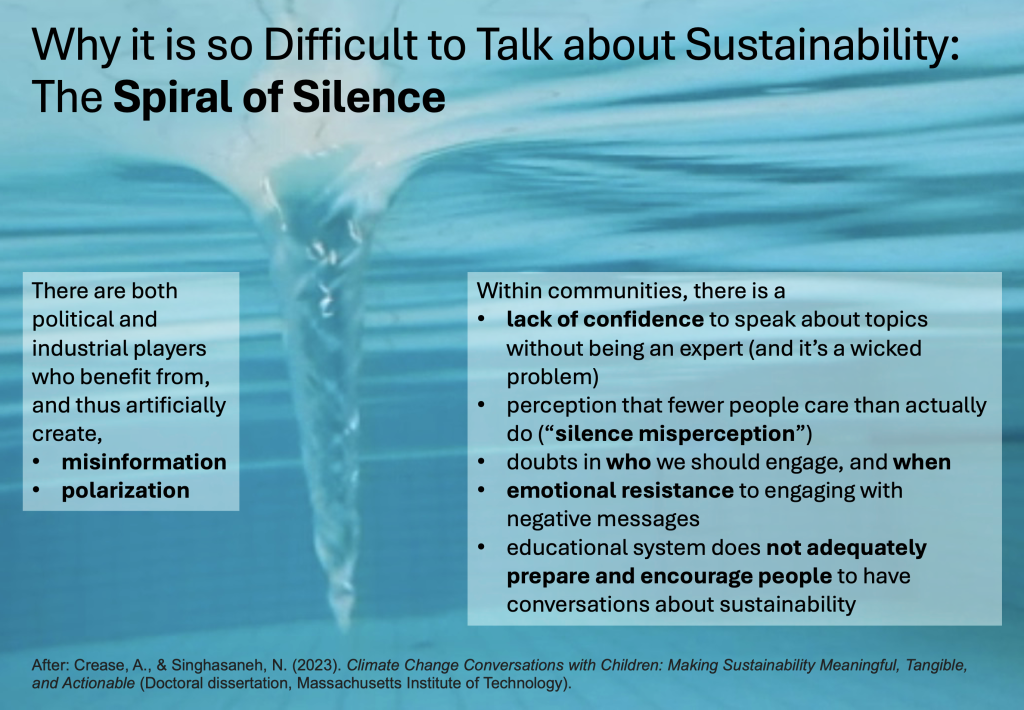
One challenge for teachers wanting to include more sustainability in their teaching is that we haven’t yet normalized talking about sustainability in all contexts. I found the “Spiral of Silence” (see figure below) in a thesis about climate change conversations with children, but I think it is a very helpful model even when thinking about talking about sustainability in higher education classrooms, or in everyday conversations, since it shows why it is so difficult to talk about sustainability:
On the one hand, there are political and economical reasons for many people to not want to have good conversations about sustainability, so there are powerful players that benefit from, and thus artificially create, misinformation and polarisation, thus inhibiting conversations.
But also within communities, there are several factors that make conversations difficult:
Many people (even teachers) feel that they don’t know enough to have conversations about sustainability. That is very relatable, but the problem is that it is a wicked problem, meaning that there is no one right solution, so there are also no experts that have a solution. Everybody has a lack of knowledge about some aspect, and we have to get over that and still engage in conversations, but be prepared to learn from and with each other, and educate ourselves
The prevailing silence on the topic of sustainability makes it seem like it is not a topic that matters to people (because otherwise they would surely be talking about it?), but that is of course a vicious circle – if we don’t talk about it because so few other people are talking about it, what will encourage them to keep talking, or get more people engaged in the conversation?
People have doubts about who to talk to, and when. We don’t want to take hope for a good future away from children, or overburden them at a too young age. But even with students some teachers feel like “here, they should focus on learning x, and I want them to focus on that and not get caught up in despair or discussions that are beyond the scope of my course”. Because if we open up for conversations that students feel a need for but don’t have any other opportunity for, this might take on a dynamic of its own! But of course at some point, someone needs to start talking somewhere
There is also just plain emotional resistance against engaging with negative messages, and that is a powerful obstacle to conversations or engagement
Lastly, the educational system does not adequately prepare or encourage people to have these conversations. But this is where we are working for change now! 🙂
I find this Spiral of Silence so helpful because it shows how complex the problem is. It is not just that there are players who don’t want us to talk about sustainability, even within ourselves there are so many obstacles to overcome! But becoming aware of those is a good first step, and maybe reflecting on which of those (and possibly other) obstacles are relevant in our individual case. And maybe a good second step is joining our community on Teams or at an in-person event and finding other teachers willing to talk, and engage, and teach for sustainability?
—
After: Crease, A., & Singhasaneh, N. (2023). Climate Change Conversations with Children: Making Sustainability Meaningful, Tangible, and Actionable (Doctoral dissertation, Massachusetts Institute of Technology).
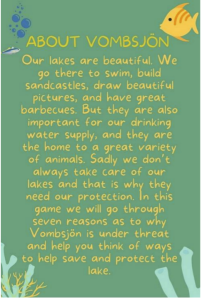
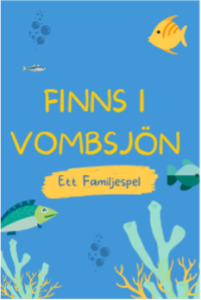
In 2022, together with my peer students in the Environmental Studies and Sustainability Science program (LUMES), I designed the game “Go Fish in Vombsjön” to highlight issues related to more sustainable water usage at Lake Vombsjön in Skåne. It’s a card game primarily aimed at children from middle school or older but can just as well be played and enjoyed by adults, regardless of their level of education or knowledge.
The best thing about the game is that learning comes along with it. It doesn’t require any special knowledge or even an interest in sustainability issues to participate. Instead, the appeal lies in the enthusiasm for participating in a social game and the desire to beat one’s opponents. Hereafter, I will briefly explain the process that made the game possible, how we designed it, and finally share my insights, as well as how you could use the game “Go Fish in Vombsjön” with your friends, colleagues, or in education.
The game is played by students at a school in Staffanstorp.
Between 2021–2023, I studied the Environmental Studies and Sustainability Science master’s program at Lund University. During our second semester in the “Knowledge to Action” course, our task was to highlight a sustainability problem in our local area, document it, and clarify the process for identifying a solution to the problem.
The working group I was part of had already initiated a dialogue with the ARNA association in the UngScishop project. ARNA works to spread knowledge about sustainability challenges through ARt and NAture. Within the UngScishop project, they work with middle school students from schools around Vombsjön to teach them about sustainability related to the area. (see more from ARNA at www.arna.nu)
Our contact with ARNA made us students curious about Vombsjön, which is the water source for Lund Municipality and several other municipalities in Skåne. An intensive period of interviews with local stakeholders around Lake Vombsjön, as well as thorough research of official documents and academic sources, enabled us to identify several different aspects that all influenced the water quality in the lake.
The group collectively concluded that a game is a good method for learning about complex subjects and engaging across generational boundaries. The well-known game “Go Fish” provided the framework for the game’s structure, with the rules being largely the same. By using an existing structure, it’s easy to learn the game, and it only takes a few minutes to start an engaging and entertaining game.
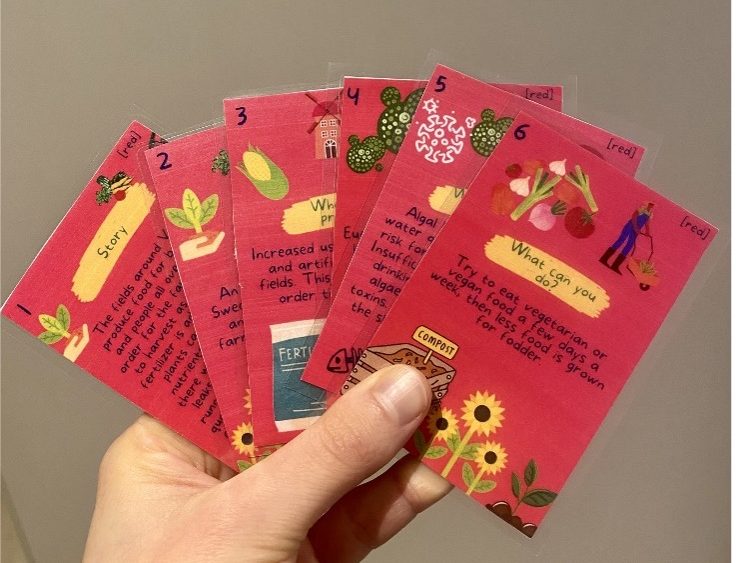
The card game consists of six categories, with each category reflecting a problem that negatively affects the water in Vombsjön. Each category consists of 5 steps that reflect the different letters in the DPSIR method, plus one card that explains the story behind the problem.
The DPSIR method is a method used in sustainability studies and is mentioned in Burkhard & Müller, 2008 *, where the different letters stand for:
D – Drive, P – Pressure, S – State, I – Impact, R – Response
To make the game accessible and move away from an academic and sometimes inaccessible jargon, we chose to translate the meaning of the letters as follows:
Drive: The root cause
Pressure: What’s the problem?
State: Current situation
Impact: What does it lead to?
Response: What can you do?
Thus, we created a deck of cards with seven categories, where each category consisted of six cards (DPSIR + a story card), and all the cards together in a category formed a family. The player who collected the most families at the end of the game wins.
All six cards of the Red family
How can the game be used?
In the introduction to this post, I mentioned that the game can be used as a social game or for educational purposes. To date, the game has been played by staff at LUCSUS and students in the LUMES master’s program, as well as with around 150 middle school students in schools around Skåne.
The idea of the game is to create understanding and insight into how complex sustainability problems are interconnected but also to provide examples of how we ourselves have power over its structural problems and that sometimes we can influence the outcome by changing our everyday actions and behaviours. At the same time, it was important for the game to be engaging and entertaining. This way, we could attract and reach groups of people who would not otherwise be exposed to this type of information.
Each card in the deck tells a story. The story describes a problem, what affects the problem, and what we can ideally do about it, thereby contributing to change. By reading one of the stories at the end of each game round and then discussing it in the group, the problems are made visible and easily accessible and understandable. We, the creators of the game, hope that each round will lead to insights and hopefully provoke discussions outside the classroom. In the long run, the game can change behaviour and contribute to more sustainable water usage around Vombsjön.
On one occasion, a class from Sjöbo got to play “Go Fish in Vombsjön”. One of the teachers shared the insight that the game doesn’t need to be played in its entirety; selected parts can form the basis for discussions and assignments in the classroom and can thus be included in the regular teaching schedule. This is beneficial since time and the set curriculum can be restricting factors when trying to introduce a new topic or activity in schools.
The story of Vombsjön told in the game
Lessons learned and critique
After each time we play-tested with a group of students, we were eager to receive feedback and any criticism. Already, at the beginning of the design process, we made sure to give each card a number, and each family should be recognizable through its colour. The colour is also printed in text, so the game can accommodate the different needs of the players and misunderstandings about the colours don’t arise. (Which is an important aspect of the game). One comment we received was that each family in the deck should have a name that reflects and summarizes the problem and the described story. Depending on the age group, the amount of text on each card can be too abundant and sometimes difficult to understand and would therefore benefit from being further shortened for the younger players’ sake.
Where can I find the game?
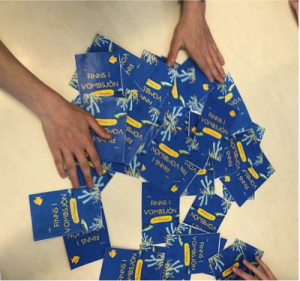
During the course of the master’s program LUMES, a deck of cards was produced in English and one in Swedish. Over time, several decks of cards have been produced in Swedish under the name “Finns i Vombsjön”. Currently, there are about 10 decks of cards, 2 of which are now found in classrooms in Skåne. Each deck consists of 47 cards, with each card being manufactured by glueing the back and front together, cutting out each card, and laminating them by hand. This is a time-consuming process, and I hope to make the game more widely available through free downloads of PDF files, where you can make as many games as you want on your own.
Would you like to borrow a game today? Then feel free to contact me at annanohed@gmail.com.
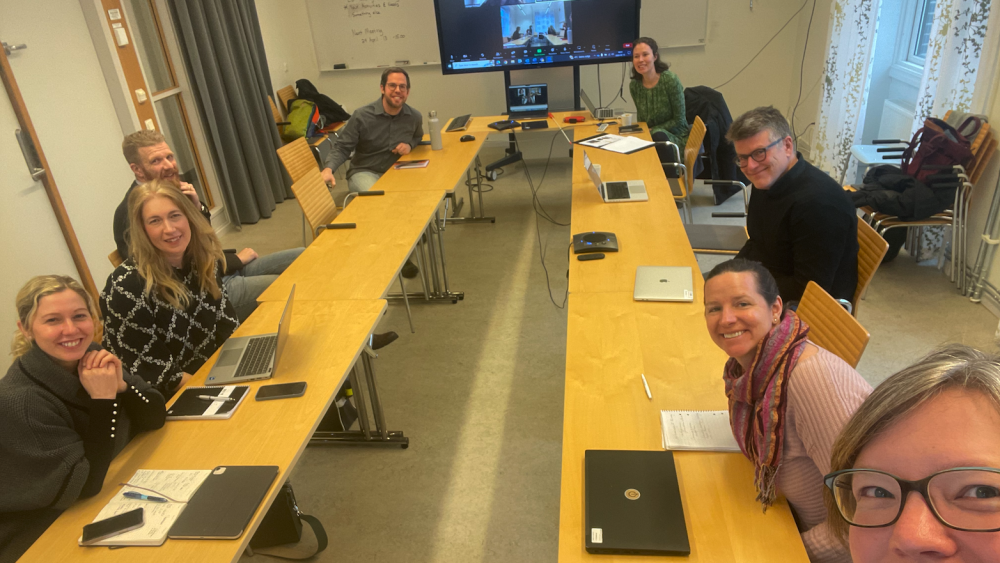
From Left to Right: Britta Sjöstedt (Senior Lecturer, Department of Law); Karin Delin (Educational Services, Faculty of Law); Magnus Sandberg (Associate Professor, Faculty of Medicine); Steven Curtis (Academic Developer, AHU); Terese Thoni (Education Coordinator, Sustainability Forum); Anders Sonesson (Head of Department, AHU); Jessika Luth Richter (Programme Director; IIIEE); Mirjam Glessmer (Academic Developer, CEE); Aysegul Sirakaya (Senior Lecturer, Faculty of Law) (online)
[Edit 21.8.2025: Please note that we have renamed the “Task Force” to “Roundtable”, and the “Working Group” to “Coordination Team”]
The “Teaching for Sustainability” work (this blog, the events we run, the resources we develop, and much more) is coordinated by Terese Thoni, the education coordinator at the Lund University Sustainability Forum, together with colleagues from the Division of Higher Education Development and the Centre for Engineering Education. We organise ourselves in the following groups:
Working Group: This is the group that engages in operational planning, with meetings at least every month (currently, Terese, Steven, Karin, and Mirjam are in this group, but we welcome anyone else who wants to get engaged here!).
Task Force: Receives information and provides input that guides the work of the working group, with meetings at least once per semester. A representative (or several) from every Faculty is invited to join the Task Force (Get in touch if you would like to join!)!
On February 13th, the Task Force met for updates, feedback and general discussions. We talked about, among other topics,
We also discussed ideas for future events (for example, Mirjam is interested in organising something along the lines of “Teaching for sustainability without necessarily teaching about sustainability”), and we welcome your suggestions here!
We will very soon advertise the fall course program!
LUTL24: The Lund University Teaching and Learning conference 2024 (https://www.ahu.lu.se/en/educational-development/lutl-2024/) has the overarching theme of “connecting teachers — changing from within”, which we think fits perfectly with our idea of creating a community of teachers that are interested in sustainability. So we are preparing different contributions there!
We also discussed needs that teachers in the different faculties experience related to their efforts in teaching for sustainability. Here we also welcome your input — what can we do to make your life easier? What topics for seminars would you suggest? What resources would you hope we provide?
As always: If you would like to get in touch, we would love for you to contact us and join us in any and all of our efforts! 🙂
Teaching for sustainability is about so much more than teaching the content and skills described in the SDGs, or even the cross-cutting sustainability competencies. Today, I talked with teachers who asked what they could do in their courses where the curriculum does not mention anything related to sustainability, and if they should even do anything. Do all courses always need to connect to sustainability? In my opinion, everything is connected to sustainability, and even if you don’t want to explicitly address it in every course and all the time, there are so many things you can do to use your teaching on any content and skills for sustainability.
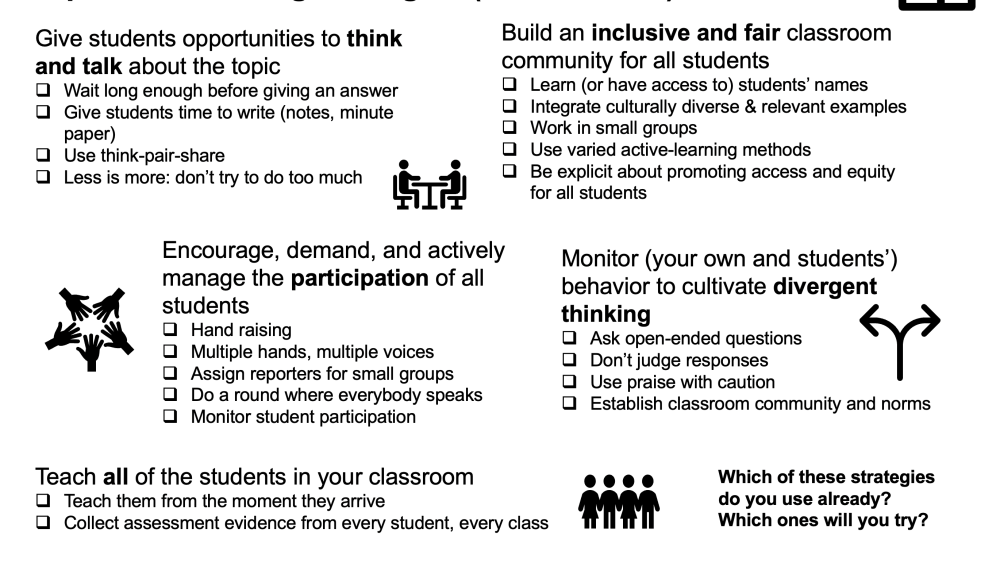
One article that I find super helpful is “Structure matters: twenty-one teaching strategies to promote student engagement and cultivate classroom equity.” (Tanner, 2013). It is not about sustainability, but it is contributing to it anyway by giving super simple teaching tricks that help teachers to pay attention that all students are invited to participate and to personally connect to the topic. In a nutshell (but go read the original article, since it not only provides a checklist but also explains why each of the strategies is important and why they work):
give all students time to think (Wait more than 2 seconds after asking a question before you answer it yourself! Let them take notes and assign minute papers!) and opportunities to talk (think-pair-share!). Most important tip here that we probably all need to consider over and over again: Don’t try to do too many things! Rushing through content does not help anyone. If students don’t have time to think and talk, they are not going to be able to integrate all the new content we throw at them into their thinking anyway, so why do it in the first place?
include all students in the larger class discussions (insist on people raising their hands so not only the fastest person shouting in gets heard; make sure you don’t always pick the same person; let several students respond to the same question in their own words; …)
build an inclusive and fair classroom community for all students (learn names [or pretend to — read my favourite “name tent” article!]; use diverse examples so people can identify and get exposed to different perspectives; let them work in small groups; use different active learning methods; talk about how you want to give all students equal access to education, and how diverse perspectives and voices are important to scientific progress. And be explicit about wanting EVERYBODY to succeed!)
monitor (your own and students’) behaviour to cultivate divergent thinking rather than training them to assume that there is always only one correct answer (open-ended questions and no judging of responses or over the top praise for engagement) and establish norms (like making mistakes is a learning opportunity; we treat each other with respect)
teach all students in your classroom. Be aware that you are establishing norms not just for your classroom but also students’ assumption of how things work in your discipline from the moment they walk in, so if you focus on explaining the exams right away, the focus of the whole course is assumed to be about the assessment in the end. If you want participation, make sure everybody gets to say something very early on. If you want to make sure you are teaching everybody, don’t just give feedback to people who are coming up to talk with you, include formative feedback for everybody through multiple-choice questions, minute papers, or other methods.
Teaching for sustainability is something that needs to be integrated not only in what we teach, but in how we teach, in which behaviour we model and demand. All of the tips above are good practice in teaching anyway, but by integrating them into our teaching culture, we are also contributing a tiny little bit to teaching for sustainability, no matter what course and content we are teaching.
Tanner, K. D. (2013). Structure matters: twenty-one teaching strategies to promote student engagement and cultivate classroom equity. CBE—Life Sciences Education, 12(3), 322-331.
I am Karin Steen, and I work at AHU (Division for Higher Education) at Lund University as a pedagogical developer. I teach university teachers in Higher Educational development and develop pedagogical resources on for example how one can teach sustainability.
I also work at LUCSUS (Lund University Centre for Sustainability Science) where I conduct most of my research. My PhD in Sustainability Science concerns gender and social change in subsistence farming in sub-Saharan Africa. At the moment, I am finishing up a project on ’Love in subsistence farming in sub-Saharan Africa’. I have mostly been teaching in international interdisciplinary programmes at Lund University social science faculty, such as BIDS, LUMID, LUMES, and master’s in development. I have also been director of studies.
Right now, I am especially interested in our new initiative Teaching for Sustainability, in anti-oppressive and feminist pedagogies, and in developing interdisciplinary sustainability education for postgraduates and PhD students in Southern Africa.
In my free time, I am interested in gardening, and I spend a lot of time contemplating in my hammock under the apple trees. I spend my summers at the sea on the Swedish west coast archipelago of Bohuslän.
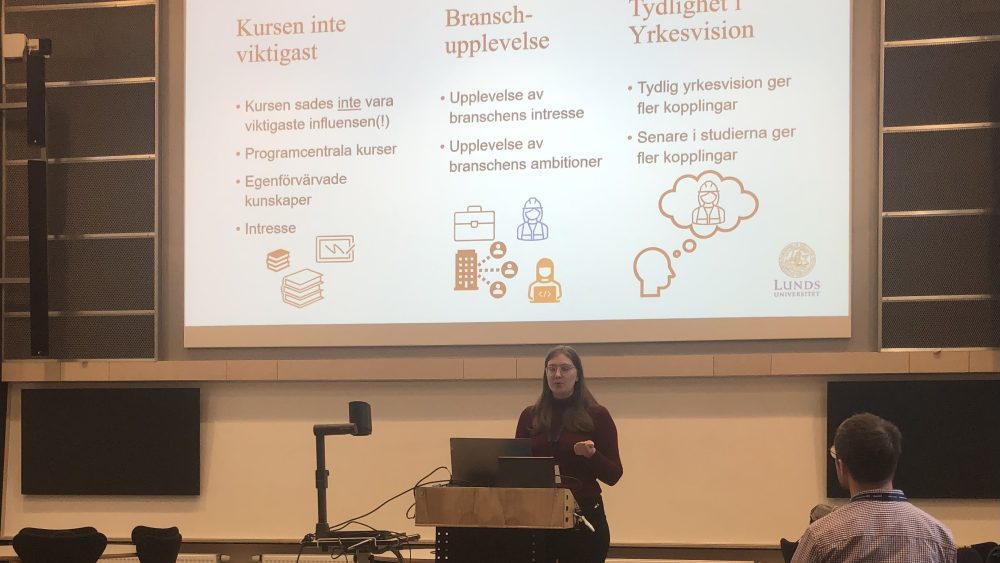
Lydia Carling is a student in Environmental Engineering at LTH, and worked as a student with us at the Center for Engineering Education. She presented a study on student perceptions of sustainability courses at LTH’s Pedagogical Inspiration Conference 2023 (Link to the full text in Swedish here).
In her study, Lydia investigates the perspective of engineering students at LTH on their sustainability education. She explores the connection between students’ envisioned, future professional roles and their perception of sustainability work, focusing on the impact of a mandatory sustainability course on students’ views of their future careers.
Her pilot study employs an interactive interview method where students visualise their future professional roles and sort sustainability concepts they encountered in the class according to their perceived relevance to their future work. The results suggest that several factors influence students’ reasoning, including the impact of the sustainability course, knowledge from more profession-specific courses, and students’ perceptions of the industry’s approach to sustainability.
The method used in the study seemed to inspire students to explore new perspectives and connections between sustainability work and their future careers, so it might even be something to include future teaching of sustainability topics. Lydia highlights the importance of integrating sustainability education into various contexts throughout students’ academic journey to enhance their ability to address sustainability questions in their professional practices. This was topic of a lively debate at LTH’s Pedagogical Inspiration Conference, with many teachers showing great interests in her method, results, and interpretations, and agreeing with Lydia’s suggestions for new approaches to integrating sustainability in the curricula.
Hi there! My name is Terese Thoni and I work as education coordinator at Lund University Sustainability Forum. The Sustainability Forum is Lund University’s umbrella organisation for strategic support and coordination for sustainability issues. We have in the past years intensified our focus on education for sustainability and to find new and interesting resources for our teachers. I support the integration of sustainability aspects in study programmes at all levels and the development of new educational initiatives focused on sustainability, collaborate with external partners, arrange events, and support networking activities. To more easily coordinate efforts in the area of education for sustainability across the whole university and all faculties, the initiative Teaching for Sustainability was created in Spring 2023, coordinated by the Sustainability Forum in collaboration with the Division for Higher Education Development and the Centre for Engineering Education (CEE) at Lund University’s Faculty of Engineering.
I have a background in research and teaching in the fields of environmental science and political science. My research interests include international climate politics and the net-zero targets, Carbon Dioxide Removal-technologies, Ecosystem-based Adaptation, and ecological compensation.
I have been interested in sustainability for as long as I can remember. My elementary school teacher often talked about deforestation, and it saddened me to think about the many animals losing their homes. I decided at an early age to work with nature protection in one way or another. I engaged in all kinds of small-scale projects as a child, from building homes for insects, to collecting trash, to taking an interest in what we eat and how this affects the environment. At the age of 8, I decided to build a compost at home in our kitchen in our small apartment in Stockholm – a decision that led to a minor bug invasion, which I found very exciting. With time, I have tried to focus less on individual change (even though I try my best to live as I learn) and more on change at a group level. I see the integration of sustainability competences in education as fundamental to our ability to address our large sustainability crises. I look forward to engaging with teachers and students and to hearing how we can best support efforts to this end.
“Teaching sustainability” is a course that aims at providing teachers who want to develop their teaching on sustainability with the opportunity to discuss and collaborate with peers on the topic, and to document their shared reasoning. This could include developing whole courses, course modules or ways to include aspects of sustainability in any course. The course addresses several global challenges we face, including poverty, inequality, climate change, environmental degradation, peace, and justice.
During this course, we will have the opportunity to
read and hear about relevant and helpful literature
carry out a group project on an issue chosen based on personal relevance (e.g., a lesson plan, teaching material, list of sustainability aspects to be included in a given course)
present and get feedback from other teachers at a presentation to other LU teachers at the course’s last meeting.
The course corresponds to 2 weeks full-time work. Note that you need to put in more work than just the scheduled meetings:
Wed 13/3 13:15 -16:00
Tue 9/4 13:15 -16:00
Tue 7/5 13:15 -16:00
Tue 4/6 13:15 -16:00
For a pass on the course, participants must have attended the initial meeting and 75% of the scheduled activities, and also passed the project report.
The course will be facilitated in English.
Audience
This event is intended for teachers at LTH, especially those who have experience in using serious games in teaching sustainability, or are considering it. But anyone interested in joining is welcome to do so! For participants from outside of LTH, standard rates apply.
Registration
Space is limited to 15 participants. Registration is open until 20.2.2024.
Many educators use serious games in their teaching to integrate educational content, skills development, and learning outcomes into a game-like environment. This promotes student engagement, critical thinking, problem-solving, and collaboration. Join us as we create a space for support and discussion about this exciting pedagogical approach.
It has become clear that there is HUGE demand from educators at Lund University to facilitate a dialogue, exchange of ideas, and experience sharing around the use of serious games as a pedagogical approach (see summary of our previous event here).
During this event, we will have the opportunity:
To briefly present your own experiences or questions;
To listen or engage in discussion with other colleagues;
To generate new ideas for how to use serious games in your teaching;
To expand your network of teachers interested in using serious games.
We want to provide the opportunity to engage in discussing topics that matter to you the most! No prior knowledge or experience is needed to attend the event; however, there will be no theoretical content provided at this event. For this information, we suggest you review the summary and slides from our previous event on this topic during Fall 2023.
We will offer this workshop as a hybrid event.
The workshop will be facilitated in English.
Date, time & calendar entry
The event will take place on 29 February 2024, 09:30 to 11:00
Space in the room is limiting us to 15 participants; however, there is a possibility to join online. Please indicate your preferred venue for participation. Registration is open until Monday 26 February. For late registration, contact mirjam.glessmer@lth.lu.se.
This event is intended for teachers at Lund University, especially those who have experience in using serious games, or are considering it, as an approach to teach sustainability. Anyone interested in joining is welcome to do so!
Venue
The event will take place at Brunnen in the Studiecentrum at LTH. The entrance is located at John Ericssons väg 4. Upon entering, signage will be visible directing you to the room location.
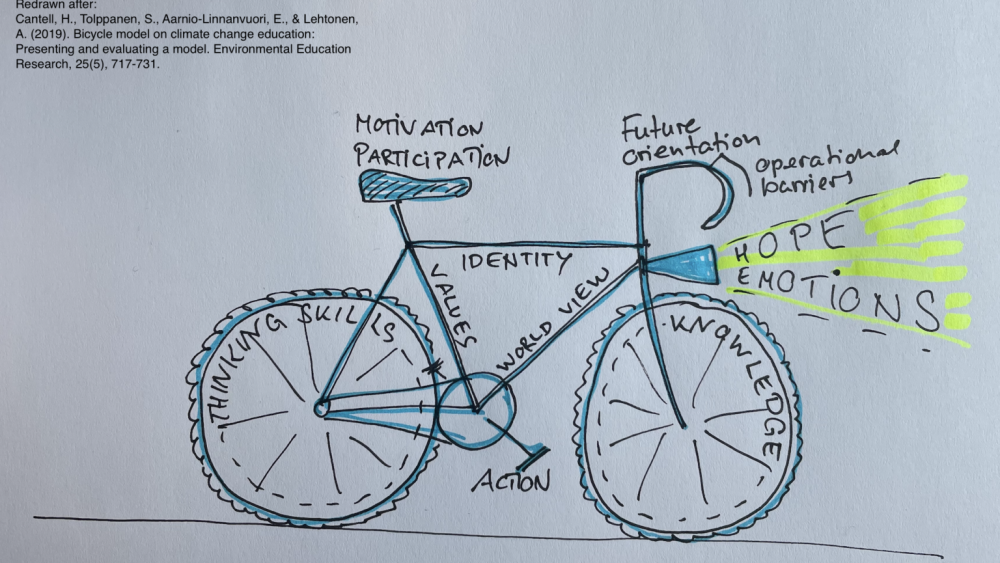
Sometimes looking at different models of what is important when teaching about complex topics can be really helpful to look at our teaching in a new way, like the Head-Hands-Heart model we shared a while back. I stuck the drawing above to our coffee corner in my office, because I think it represents a really useful model for thinking about teaching about topics like sustainability, or climate change (which it was originally developed for). The model was developed by Cantell et al. (2019), where they used research in Climate Change Education and combined all the important elements into the “bicycle model”.
The model uses the analogy of a bicycle with its essential components to move forward:
Two wheels. In the model, one represents knowledge, the other thinking skills, both of which are necessary and need to play together, but neither is sufficient on its own.
A frame. All new knowledge and skills will be brought together and interpreted through the lens of the learner’s identity, values, and world view.
Chains and pedals. This represents the “real life” action that is necessary to make things move.
The saddle. In order for people to be willing to ride the bike of climate change action, motivation needs to be supported, and often that means doing things in a community and participating in something bigger.
Brakes. Not all action will lead to the desired results, sometimes there are barriers to operation, and they need to be understood and dealt with (here, in my opinion, the analogy breaks down a little bit, since the breaks on a bike are actually serving a desirable purpose in a bike. But maybe we also sometimes need to slow down and re-evalute?)
The lamp. This signifies the importance of emotions, and especially of hope, in order to scout out and decide on the way forward.
A handlebar. This is the future orientation, the vision of where to go and how to steer in the right direction to get there.
In their evaluation, Cantell et al. (2019) find that the model is useful in visualizing the complex nature of CCE, keeping it in mind when planning teaching, and even using it as a tool to evaluate teaching. It supports pedagogical reflection and I really like how easy it is to grasp all the important elements without a lot of explanations. Interestingly, the brakes that I criticize above, too, are also discussed critically, with some of the experts disagreeing with the authors on whether or not they should be included. But I agree with the authors that people need to be aware that there are barriers and what they are, so they can prepare adequately and don’t get frustrated by something that would have been foreseeable, and that discussion of common barriers helps understand each other and our behavior, so we can more easily cooperate.
The discussion-part on possible future developments of the model is also super interesting. We need collaborative action, so should we have a tandem instead? But that would take away agency from one of the cyclists, and also it would be much more difficult to move the tandem alone, even though sometimes that might be necessary. But they suggest to draw several bikes together to include that aspect, which works to make the point, but which I would then probably leave to the imagination of the reader.
How does this model help you in thinking about your teaching about sustainability? How would you modify it, or what would you use instead?
Cantell, H., Tolppanen, S., Aarnio-Linnanvuori, E., & Lehtonen, A. (2019). Bicycle model on climate change education: Presenting and evaluating a model. Environmental Education Research, 25(5), 717-731.
We often think of possible responses to fear as fight, flight, or freeze. It is easy to transfer this thinking on our teaching about topics like sustainability and climate change: in response to realising the extent of the problems we are facing, students can step up and take action, they can just not engage with the material and ignore the threat as much as possible (if I don’t think about it, it can’t be real, can it?), or they can get paralysed by the enormity of the problem. Obviously, the first option is what we want to achieve, but we have seen disengaged students and inaction often enough to be worried that exposing students to fear-inducing messages will lead to those reactions.
Tannenbaum et al. (2015) investigate the literature on “fear appeals”: messages designed to change behaviour though creating fear in the recipients that if they don’t follow that message’s advice, the consequences will harm them. In their meta-analysis of 127 articles on different aspects of fear appeals, Tannenbaum et al. (2015) consider many different facets that can potentially influence whether a fear appeal works or not: what exactly the message is, the desired behaviour, and who the audience is.
They come to the surprising conclusion that “(a) fear appeals are effective at positively influencing attitude, intentions, and behaviors; (b) there are very few circumstances under which they are not effective; and (c) there are no identified circumstances under which they backfire and lead to undesirable outcomes.”
The authors find that fear appeals are most effective when the message
is written in a way that relatively high amounts of fear are intended,
includes a message reassuring the recipient that they are capable of something to mitigate undesired outcomes and that those actions will have an effect,
makes both the personal relevance and the severity of the danger conveyed in the message very clear,
targets a one-off behaviour rather than a repeated one,
and when the audience is mostly female.
What this study explicitly does not answer, however, is the influence of the source of the fear appeal (is it trustworthy? Perceived as benvolent or biased?) and the way fear appeals are delivered (e.g. graphic or audio? Social vs mass media?).
It does also not become clear how exactly this translates into teaching. Of course that was never the goal of the article, but that’s the lens through which I read it, specifically how should we deal with fear appeals when we teach about climate change or biodiversity loss? If fear appeals work best on mostly female audiences, what does that mean for our mostly male students at LTH? Are fear appeals still a promising way to go then? And we probably want repeated and sustained action, not just a one time effort?
But even with those questions unanswered, it is good to see confirmation that the positive, constructive messages, stressing what individual and collective action people can take, that “we can fix it“, are the way to go, and that — and this part I did not realise before — the fear appeal should be very concrete, focussing on the risk of personal harm and what that would look like. And — according to this study — the risk of this back-firing is very low!
Does this help you figure out how to approach difficult topics, like for example biodiversity loss, with students? For example rather than talking in general terms, point out the very local, very personal consequences of inaction, and then let them develop the actions that they can do and that will have a positive impact. And then we can always build on that later with a wider perspective.
What do you think? Let us know!
Literature:
Tannenbaum, M. B., Hepler, J., Zimmerman, R. S., Saul, L., Jacobs, S., Wilson, K., & Albarracín, D. (2015). Appealing to fear: A meta-analysis of fear appeal effectiveness and theories. Psychological bulletin, 141(6), 1178.
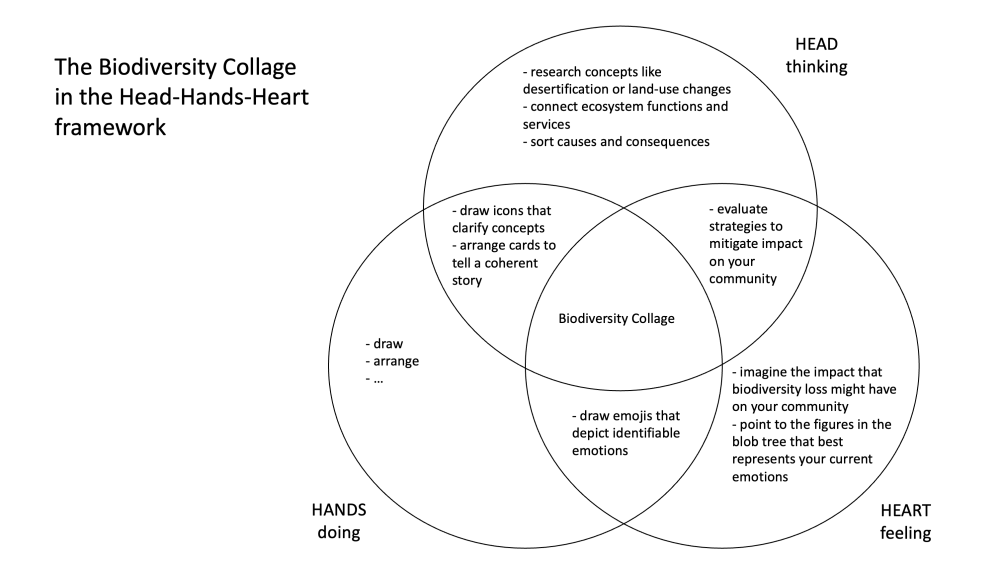
One framework that seems to be very helpful when planning teaching about sustainability is the “head, hands, and heart” framework. I am using the term “framework” loosely — it is basically a Venn diagram of three overlapping areas:
intellectual aspects: the “thinking” part that most of university teaching focusses on and that we as teachers probably feel most comfortable with. Typical activities might be listening to lectures, reading scientific articles, writing reports, solving practice exercises in groups, maybe keeping learning journals
practical aspects: the “doing” aspects that are a lot less common in most study programs. Maybe there are some skills that are being taught, like using a software to design a poster that efficiently conveys information, building sound structures out of materials that are provided, using specific measurement instrumentation
emotional aspects: the “feeling” aspects that many teachers try to not get too close to, but that could include for example reflecting on values or how it feels to work in a specific group, learning how to deal with conflicts in group work, or how to motivate yourself to do something you aren’t yet motivated to do
Where these areas overlap, things get a bit more interesting.
Head and hands combines for example designing and building, reading an instrument manual and operating the instrument, …
Head and heart combines for example intellectually understanding a topic and translating it into a science poem, designing a questionnaire to figure out what needs a specific community has, …
Hands and heart combines making something for someone else’s benefit
Lastly, where head, heart, and hands overlap, students do something that is intellectually challenging and stimulating, but where they also get into the practical implementation of creating a tangible outcome that is connected to a cause and a community they care deeply about. This is what we want to aim for when teaching about sustainability, it is here that the magic is happening, students are engaged and transformed.
This framework was developed by several teams of authors independently of each other and through very different approaches, which only strengthens it in my eyes.
For Sipos et al. (2008), it was a pragmatic approach to integrating sustainability in existing curricula and still achieving transformative learning. They have two premises: 1) Students’ learning is localised, both at university in a formal context, where it is often broken into distinct subjects that are taught completely independent of each other, and in the rest of their lives, i.e. their homes, leisure-time activities, etc. This will lead to conflicts between what is learned in different contexts, unless 2) learning is situated across all those contexts in the first place, and university purposefully integrates all the non-university contexts with the other relevant communities.
Öhman and Sund (2021) develop a similar framework based on educational theories and postulate that sustainability commitment is found where the three areas overlap.
So how can this framework be useful for teachers?
Firstly, just talking about it helps raising the importance of challenging students in more areas than just intellectually, and generating conversations about how this can be done in general and more specifically. Many teachers want to support students in their emotional development and engage them in activities that are meaningful to them, but don’t necessarily feel equipped or allowed to do so.
Then, this framework is helpful as a tool to reflect on our own teaching. If we map all the activities in our course onto the different areas, are there any in the hands and hearts parts, and where the two overlap?
Lastly, it can be very useful to do a similar mapping exercises with planned teaching to check which aspect our focus is on. Most likely the intellectual part, and that’s ok! But maybe there are ways we can and want to add in some emotions or practical aspects? Or, as in the image above that maps the activities in the serious game “Biodiversity Collage” (see here for our event summary), the “hands” part is really not very inspiring. Which is true — there is really no artefact being produced that has any impact beyond the workshop itself (except if you use the collage like Léa did: she has done a competition around the best-annotated collage, which she then uses throughout the semester as organiser and to put content in the bigger context).
Sipos, Y., Battisti, B., & Grimm, K. (2008). Achieving transformative sustainability learning: engaging head, hands and heart. International Journal of Sustainability in Higher Education.
Öhman, J., & Sund, L. (2021). A didactic model of sustainability commitment. Sustainability, 13(6), 3083.



Comments