
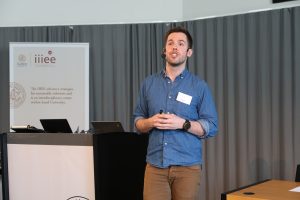
“The classroom remains the most radical space of possibility in the academy.„
— bell hooks
My Pedagogy
The challenges that face us are complex, spanning environmental, social, cultural, political, and economic crises. Thus, I believe we need bold and transformative approaches to empower ourselves and each other. From where else in society, but in higher education, are we able to facilitate the knowledge and skills development to foster competencies of critical thinking, diligence, emotional intelligence, and resilience.
Concepts like education for sustainability provide a framework to overcome disciplinary boundaries, by considering academic, historical, and anscentral insights applied holistically to real-world challenges. However, these approaches are not prescriptive, but emancipatory, by creating the conditions for learners to develop ideas and skills independently. Thus, I see my role as an educator to ask questions, encourage creativity and curiosity, challenge assumptions (including my own), and support learners to fulfil their individual aspirations.
My Profession
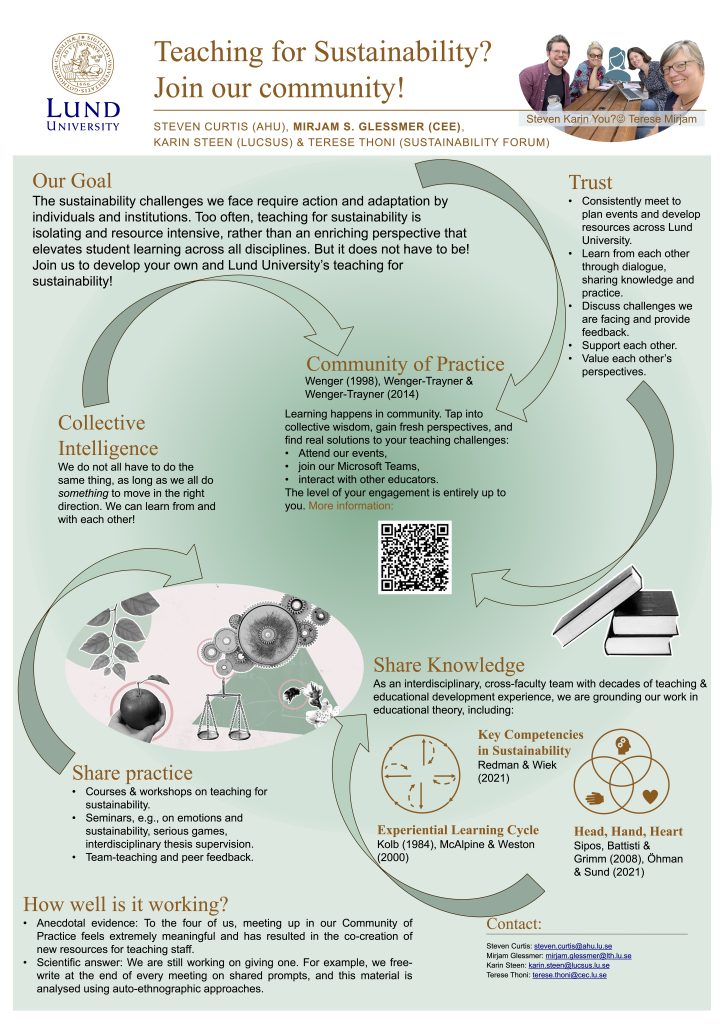
My name is Steven Kane Curtis; I am an academic developer at the Division for Higher Education Development (AHU) at Lund University. I began this role in March 2023, where I am responsible for the provision of several of our basic pedagogy courses for teachers within higher education at Lund University. AHU is a central unit providing pedagogical training for educators and supervisors in our bachelors, masters, and doctoral programmes.
My previous education and research experience is in sustainability science, having taught courses in environmental science, research methods, and academic writing. I completed my PhD in June 2021, exploring sustainable business models within the sharing and circular economies. Moreover, I initiated and co-hosted the podcast ‘Advancing Sustainable Solutions’, where we communicated sustainability research to a general audience. In doing so, we aimed to democratise academic knowledge and articulate complexity in a digestible way for an interested audience. The podcast grew to be recognised in the top 10% of all podcasts globally, based on listenership.
Listen to past episodes of ‘Advancing Sustainable Solutions’ – transistor.fm
My Passion
In my personal life, I live on a small homestead among the forests of Småland in Sweden. There, my partner and I integrate permaculture and circular strategies to work with nature and revitalise the land and infrastructure. Thus, I spend a lot of my time reading books and engaging with content about permaculture and holistic management.
I absolutely love finding parallels between my passion for gardening and teaching. For example, permaculture advocates twelve principles, which guide the design and implementation of systems working with nature. I can’t help but identify several parallels with how one may teach, especially leveraging concepts like education for sustainability. Here are some of the permaculture principles, which are reflected in my teaching philosophy:
- Use and value diversity
- Creatively use and respond to change
- Observe and interact
- Self-regulate and accept feedback
- Design from patterns to details/context
- Integrate rather than segregate
By sharing this, I want to challenge you to explore the ways in which your personal passions either influence or can be shared as part of your teaching. Perhaps you play an instrument – consider starting your class with music; maybe you love to paint – how may colour theory be a useful metaphor to support learning?; for those that have children – what is something from a children’s book, which could inspire a discussion among your students? The possibility for creativity and authenticity are endless!
By connecting your passion with your profession, I hope we all can find meaning in our role as teacher and educator. For me, it is the most profound and impactful activity I can imagine, as we support our students to be able to respond to and address our sustainability challenges.
Should you wish to discuss your passion, profession, or pedagogy, don’t hesitate to get in touch!
You can reach my by email:

Comments